Have you ever noticed how quickly your body reacts when something feels threatening?
Your heart begins to beat faster.
Your muscles tense.
Your breathing changes.
Sometimes this happens before you even understand what is wrong.
Why does the body react so quickly?
The answer lies in a powerful biological system that has been helping humans survive for thousands of years.
Stress Is Not Just a Feeling
Many people think of stress as an emotion. But stress is actually a whole-body response.
When the brain detects danger, it activates systems designed to prepare the body to respond.
This response can prepare us to:
• fight
• run away
• freeze and stay alert
This system evolved when human survival depended on reacting quickly to physical danger.
Today, the same system is activated by very different experiences:
• uncertainty about the future
• conflict in relationships
• overwhelming responsibilities
• social pressure or rejection
Even though the threats may not be physical, the body still reacts as if survival is at stake.
Many people think of stress as an emotion. But stress is actually a whole-body response
When the brain detects danger, it activates systems designed to prepare the body to respond.
This response can prepare us to:
• fight
• run away
• freeze and stay alert
This system evolved when human survival depended on reacting quickly to physical danger.
Today, the same system is activated by very different experiences:
• uncertainty about the future
• conflict in relationships
• overwhelming responsibilities
• social pressure or rejection
Even though the threats may not be physical, the body still reacts as if survival is at stake.
The Brain’s Early Warning System
Deep inside the brain sits a small structure called the amygdala.
The amygdala acts like an alarm system. It constantly scans our environment for possible threats.
When the amygdala detects something dangerous or uncertain, it sends signals that trigger the stress response.
What makes the amygdala remarkable is how quickly it works.
In many situations, the amygdala reacts before the rational thinking part of the brain has time to analyze the situation.
This is why we sometimes feel fear, anxiety, or tension before we can explain why.
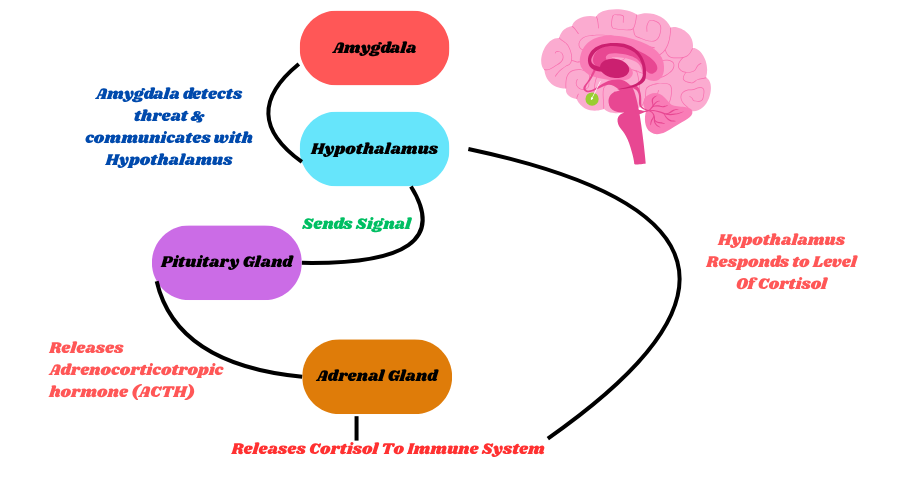
The Brain Sends Signals to the Body
Once the amygdala detects a threat, it communicates with another important brain structure called the hypothalamus.
The hypothalamus acts as a command center linking the brain and the body.
Through this system, the brain activates a network called the HPA axis.
The HPA axis stands for:
• Hypothalamus
• Pituitary gland
• Adrenal glands
These structures work together to release stress hormones.
Cortisol: The Body’s Stress Hormone
One of the most important hormones released during stress is cortisol.
Cortisol helps prepare the body for action.
It can:
• increase energy availability
• sharpen attention
• raise blood sugar levels
• temporarily reduce non-essential body processes
In the short term, this response is extremely helpful. It allows us to focus, react quickly, and deal with challenges.
But when stress becomes chronic, the body remains in a prolonged state of activation.
Over time, research shows that chronic stress may affect:
• sleep quality
• immune function
• memory and learning
• mood regulation
• digestion
Stress in the Modern World
The human stress response evolved to deal with immediate physical danger.
In modern life, however, the most common stressors are psychological and social.
A difficult conversation.
Financial uncertainty.
Academic pressure.
Feeling disconnected from others.
These experiences can activate the same biological stress systems that once helped our ancestors survive in the wild.
A Different Way to Think About Stress
Understanding the biology of stress can change how we interpret our experiences.
Stress responses are not signs of weakness or personal failure. They are signals from a deeply complex system that evolved to protect us.
Our brains and bodies are constantly trying to help us navigate uncertainty, challenge, and change.
When we begin to understand these systems, we can approach our reactions with more curiosity and compassion.
A Question to Reflect On
If stress is the body’s way of trying to protect us…what might our stress responses be trying to tell us about our lives, our relationships, and the environments we are part of?
Learning to understand these signals may be one of the first steps toward better mental and emotional health
Hi Divya,
I wanted to reach out and share how much I appreciated your breakdown of such a complex biological process. What stands out most is the shift in perspective—moving from seeing stress as a problem to be fixed to viewing it as an “ancient guardian” that simply hasn’t updated its software for the 21st century.
Your closing question was particularly touching. By shifting the focus from trying to silence our stress to asking what the signal is trying to protect, it becomes clear that the answer is often rooted in our values rather than immediate survival. We feel stress about a relationship because we value connection, or about work because we value competence and security.
I would love to hear your thoughts on what you believe is the hardest part about “listening” to those signals when the body is already in a state of high alert.
Dear Uday,
Thank you for reading. You asked what makes it hardest to listen to those signals when the body is already in high alert, and I think that is the moment when the nervous system is simply trying to protect us, not help us reflect. In that state the signal can feel overwhelming, even when it is pointing toward something we deeply value. Learning to pause and bring the body back to steadiness through simple vagus nerve activation practices like slow breathing, humming, or gentle movement can help us hear the signal without being overtaken by it. I will be sharing a short article soon exploring this idea further.
Hi Divya,
Thank you for your thoughtful explanation regarding the nervous system’s protective response during high-alert states.
I appreciate the insight into how simple practices like slow breathing and vagus nerve activation can help manage these overwhelming signals.
I look forward to reading your upcoming article for a deeper exploration of these concepts.